 I have a confession to make: I consciously and blatantly break the law on a daily basis. Every morning, I kiss my wife and children goodbye, and ride my bicycle slowly along a 5-kilometre stretch of protected bikeway to my office, where I work as a Residential Designer. It is a simple act. One that should be encouraged and celebrated, as it is in 99% of the world’s great cities. But rather, because I choose to do this without a piece of Styrofoam on my head, I am labeled a criminal, and face being charged by the Vancouver Police Department under Section 184 of the Motor Vehicle Act (as I have twice). This despite the fact I am not riding a Motor Vehicle, that I feel perfectly safe riding the city’s plentiful bike lanes, that I am statistically safer than a pedestrian crossing the street or even a driver sitting into a car, and that my choice of transport is far more economically and environmentally beneficial to the city.
When British Columbia first passed its adult bicycle helmet law in 1995, it was widely accepted as a sensible initiative to promote and increase road safety. The City of Vancouver followed suit shortly thereafter, passing a by-law that made it illegal to ride on city paths and seawalls without a helmet, under punishment of a $100 fine. Now, seventeen years later, it is undeniable these laws have not resulted in any of the benefits that were promised. They have not saved lives. They have not reduced healthcare costs. They have not increased road safety. It is therefore not surprising that only a handful of jurisdictions (BC followed Australia and New Zealand; the Maritime provinces followed us; then nothing) have since instituted such laws, while the rest of the world has recognized them for what they are: a complete disaster.
The most significant impact of criminalizing cycling without a helmet is the simple fact that the majority of people won’t bother. In particular, short, slow, utilitarian pedestrian-like bicycle trips to the grocery store or restaurant become a rarity. In a province facing the growing healthcare costs of 1.5 million obese or overweight people, this is of grave concern: especially when it is abundantly clear that the health benefits of cycling far outweigh the risks. Almost every study on the impact of mandatory helmet laws show a 30%-50% decrease in cycling rates, and up to 80% in some demographic groups, such as young females. The cost of this inactivity to society, in both lives and dollars, is monumental. It has been estimated that New Zealand’s helmet law contributes to 53 premature deaths per year, while Australia’s costs the taxpayer around $301-million in healthcare expenses annually.
Bike-share systems are another area where mandatory helmet laws become extremely problematic. Since the Vélib’ launched in Paris five years ago, the City of Vancouver has been studying the idea of a bike-share of our own. The lengthy delay has been down to one factor: how do you force people to wear helmets for a spontaneous, short trip on a shared bicycle? Meanwhile, over 300 cities around the world have passed us by, including such cycling hotbeds as Omaha, Houston, and Kansas City. Only three have attempted to do so under a helmet law: Melbourne, Brisbane, and Auckland, all of which were colossal failures. Vancouver tentatively plans to launch a system in spring of 2013, which will be significantly smaller than its Montreal and Toronto counterparts, and (laughably) includes helmet-dispensing and sanitizing machines. All of this notwithstanding the fact bike-share programs have proven to be incredibly safe; London, with far fewer traffic-calmed streets than Vancouver, hasn’t experienced a single serious injury after 4.5 million trips.
Unfortunately, neither the BC Liberals nor the NDP want to revisit this law, which also remains popular amongst the motoring majority: drivers who are freely allowed to smoke, drink, and eat as much fast food as they want, with no thought of the healthcare costs they impose. Even more disappointing has been the lack of leadership from Vancouver City Council, with Mayor Robertson and Councilor Deal both calling the law “appropriate”, and insisting the long-delayed bike-share program will proceed without any exemption.
However, there is a small but growing number of local activists who are speaking out against the law, calling themselves “The Church of Sit-Up Cycling” (in reference to one exemption from the BC helmet law: “conflict with an essential religious practice”) and launching a call to action: http://www.helmetchoice.ca. I stand proudly with the “Church”: the adult helmet law is a direct contradiction to our city’s goal of becoming the “World’s Greenest” in eight short years. It’s time to abandon the idea of helmet regulation, and try something new: increasing cycling safety through numbers and infrastructure, as they do in Copenhagen, Amsterdam, Tokyo, Montreal, and New York City. Then, and only then, will the bicycle stand a chance of becoming a viable and widely accepted mode of transportation in Vancouver. I, for one, can’t wait.
All photos and words by Chris Bruntlett, unless otherwise noted.
I have a confession to make: I consciously and blatantly break the law on a daily basis. Every morning, I kiss my wife and children goodbye, and ride my bicycle slowly along a 5-kilometre stretch of protected bikeway to my office, where I work as a Residential Designer. It is a simple act. One that should be encouraged and celebrated, as it is in 99% of the world’s great cities. But rather, because I choose to do this without a piece of Styrofoam on my head, I am labeled a criminal, and face being charged by the Vancouver Police Department under Section 184 of the Motor Vehicle Act (as I have twice). This despite the fact I am not riding a Motor Vehicle, that I feel perfectly safe riding the city’s plentiful bike lanes, that I am statistically safer than a pedestrian crossing the street or even a driver sitting into a car, and that my choice of transport is far more economically and environmentally beneficial to the city.
When British Columbia first passed its adult bicycle helmet law in 1995, it was widely accepted as a sensible initiative to promote and increase road safety. The City of Vancouver followed suit shortly thereafter, passing a by-law that made it illegal to ride on city paths and seawalls without a helmet, under punishment of a $100 fine. Now, seventeen years later, it is undeniable these laws have not resulted in any of the benefits that were promised. They have not saved lives. They have not reduced healthcare costs. They have not increased road safety. It is therefore not surprising that only a handful of jurisdictions (BC followed Australia and New Zealand; the Maritime provinces followed us; then nothing) have since instituted such laws, while the rest of the world has recognized them for what they are: a complete disaster.
The most significant impact of criminalizing cycling without a helmet is the simple fact that the majority of people won’t bother. In particular, short, slow, utilitarian pedestrian-like bicycle trips to the grocery store or restaurant become a rarity. In a province facing the growing healthcare costs of 1.5 million obese or overweight people, this is of grave concern: especially when it is abundantly clear that the health benefits of cycling far outweigh the risks. Almost every study on the impact of mandatory helmet laws show a 30%-50% decrease in cycling rates, and up to 80% in some demographic groups, such as young females. The cost of this inactivity to society, in both lives and dollars, is monumental. It has been estimated that New Zealand’s helmet law contributes to 53 premature deaths per year, while Australia’s costs the taxpayer around $301-million in healthcare expenses annually.
Bike-share systems are another area where mandatory helmet laws become extremely problematic. Since the Vélib’ launched in Paris five years ago, the City of Vancouver has been studying the idea of a bike-share of our own. The lengthy delay has been down to one factor: how do you force people to wear helmets for a spontaneous, short trip on a shared bicycle? Meanwhile, over 300 cities around the world have passed us by, including such cycling hotbeds as Omaha, Houston, and Kansas City. Only three have attempted to do so under a helmet law: Melbourne, Brisbane, and Auckland, all of which were colossal failures. Vancouver tentatively plans to launch a system in spring of 2013, which will be significantly smaller than its Montreal and Toronto counterparts, and (laughably) includes helmet-dispensing and sanitizing machines. All of this notwithstanding the fact bike-share programs have proven to be incredibly safe; London, with far fewer traffic-calmed streets than Vancouver, hasn’t experienced a single serious injury after 4.5 million trips.
Unfortunately, neither the BC Liberals nor the NDP want to revisit this law, which also remains popular amongst the motoring majority: drivers who are freely allowed to smoke, drink, and eat as much fast food as they want, with no thought of the healthcare costs they impose. Even more disappointing has been the lack of leadership from Vancouver City Council, with Mayor Robertson and Councilor Deal both calling the law “appropriate”, and insisting the long-delayed bike-share program will proceed without any exemption.
However, there is a small but growing number of local activists who are speaking out against the law, calling themselves “The Church of Sit-Up Cycling” (in reference to one exemption from the BC helmet law: “conflict with an essential religious practice”) and launching a call to action: http://www.helmetchoice.ca. I stand proudly with the “Church”: the adult helmet law is a direct contradiction to our city’s goal of becoming the “World’s Greenest” in eight short years. It’s time to abandon the idea of helmet regulation, and try something new: increasing cycling safety through numbers and infrastructure, as they do in Copenhagen, Amsterdam, Tokyo, Montreal, and New York City. Then, and only then, will the bicycle stand a chance of becoming a viable and widely accepted mode of transportation in Vancouver. I, for one, can’t wait.
All photos and words by Chris Bruntlett, unless otherwise noted.

Showing posts with label bike infrastructure. Show all posts
Showing posts with label bike infrastructure. Show all posts
3.03.2015
Chris Bruntlett Is a Criminal, according to Vancouver's Mandatory Helmet Law
Chris Bruntlett, blogger, writer, bike advocate from Vancouver, B.C. has some insight regarding the effectiveness of a mandatory helmet law for cyclists, as is currently proposed in California. We can learn from the failure of this law in Vancouver. This article first appeared in Hush Magazine on August 7, 2012. Please note: statistics cited may be outdated.
Take it away, Chris.
“When it comes to the big helmet debate, I believe in choice. Much like many other things in life, such as; smoking, drinking, eating fast food, and having unprotected sex. All of which affect our health care system far more than riding your bike around the seawall without a hideous mushroom cap on your dome. Are we going to make it the law to wear a condom or give out tickets to fat people? I am not opposed to wearing helmets, especially for children, and if one often takes long rides in traffic or along the highway, but for a leisurely ride around Vancouver? I choose to not wear one, and I think people should decide what’s right for them, like most places around the world.” -Mimi Lauzon, Bicycle Babes
 I have a confession to make: I consciously and blatantly break the law on a daily basis. Every morning, I kiss my wife and children goodbye, and ride my bicycle slowly along a 5-kilometre stretch of protected bikeway to my office, where I work as a Residential Designer. It is a simple act. One that should be encouraged and celebrated, as it is in 99% of the world’s great cities. But rather, because I choose to do this without a piece of Styrofoam on my head, I am labeled a criminal, and face being charged by the Vancouver Police Department under Section 184 of the Motor Vehicle Act (as I have twice). This despite the fact I am not riding a Motor Vehicle, that I feel perfectly safe riding the city’s plentiful bike lanes, that I am statistically safer than a pedestrian crossing the street or even a driver sitting into a car, and that my choice of transport is far more economically and environmentally beneficial to the city.
When British Columbia first passed its adult bicycle helmet law in 1995, it was widely accepted as a sensible initiative to promote and increase road safety. The City of Vancouver followed suit shortly thereafter, passing a by-law that made it illegal to ride on city paths and seawalls without a helmet, under punishment of a $100 fine. Now, seventeen years later, it is undeniable these laws have not resulted in any of the benefits that were promised. They have not saved lives. They have not reduced healthcare costs. They have not increased road safety. It is therefore not surprising that only a handful of jurisdictions (BC followed Australia and New Zealand; the Maritime provinces followed us; then nothing) have since instituted such laws, while the rest of the world has recognized them for what they are: a complete disaster.
The most significant impact of criminalizing cycling without a helmet is the simple fact that the majority of people won’t bother. In particular, short, slow, utilitarian pedestrian-like bicycle trips to the grocery store or restaurant become a rarity. In a province facing the growing healthcare costs of 1.5 million obese or overweight people, this is of grave concern: especially when it is abundantly clear that the health benefits of cycling far outweigh the risks. Almost every study on the impact of mandatory helmet laws show a 30%-50% decrease in cycling rates, and up to 80% in some demographic groups, such as young females. The cost of this inactivity to society, in both lives and dollars, is monumental. It has been estimated that New Zealand’s helmet law contributes to 53 premature deaths per year, while Australia’s costs the taxpayer around $301-million in healthcare expenses annually.
Bike-share systems are another area where mandatory helmet laws become extremely problematic. Since the Vélib’ launched in Paris five years ago, the City of Vancouver has been studying the idea of a bike-share of our own. The lengthy delay has been down to one factor: how do you force people to wear helmets for a spontaneous, short trip on a shared bicycle? Meanwhile, over 300 cities around the world have passed us by, including such cycling hotbeds as Omaha, Houston, and Kansas City. Only three have attempted to do so under a helmet law: Melbourne, Brisbane, and Auckland, all of which were colossal failures. Vancouver tentatively plans to launch a system in spring of 2013, which will be significantly smaller than its Montreal and Toronto counterparts, and (laughably) includes helmet-dispensing and sanitizing machines. All of this notwithstanding the fact bike-share programs have proven to be incredibly safe; London, with far fewer traffic-calmed streets than Vancouver, hasn’t experienced a single serious injury after 4.5 million trips.
Unfortunately, neither the BC Liberals nor the NDP want to revisit this law, which also remains popular amongst the motoring majority: drivers who are freely allowed to smoke, drink, and eat as much fast food as they want, with no thought of the healthcare costs they impose. Even more disappointing has been the lack of leadership from Vancouver City Council, with Mayor Robertson and Councilor Deal both calling the law “appropriate”, and insisting the long-delayed bike-share program will proceed without any exemption.
However, there is a small but growing number of local activists who are speaking out against the law, calling themselves “The Church of Sit-Up Cycling” (in reference to one exemption from the BC helmet law: “conflict with an essential religious practice”) and launching a call to action: http://www.helmetchoice.ca. I stand proudly with the “Church”: the adult helmet law is a direct contradiction to our city’s goal of becoming the “World’s Greenest” in eight short years. It’s time to abandon the idea of helmet regulation, and try something new: increasing cycling safety through numbers and infrastructure, as they do in Copenhagen, Amsterdam, Tokyo, Montreal, and New York City. Then, and only then, will the bicycle stand a chance of becoming a viable and widely accepted mode of transportation in Vancouver. I, for one, can’t wait.
All photos and words by Chris Bruntlett, unless otherwise noted.
I have a confession to make: I consciously and blatantly break the law on a daily basis. Every morning, I kiss my wife and children goodbye, and ride my bicycle slowly along a 5-kilometre stretch of protected bikeway to my office, where I work as a Residential Designer. It is a simple act. One that should be encouraged and celebrated, as it is in 99% of the world’s great cities. But rather, because I choose to do this without a piece of Styrofoam on my head, I am labeled a criminal, and face being charged by the Vancouver Police Department under Section 184 of the Motor Vehicle Act (as I have twice). This despite the fact I am not riding a Motor Vehicle, that I feel perfectly safe riding the city’s plentiful bike lanes, that I am statistically safer than a pedestrian crossing the street or even a driver sitting into a car, and that my choice of transport is far more economically and environmentally beneficial to the city.
When British Columbia first passed its adult bicycle helmet law in 1995, it was widely accepted as a sensible initiative to promote and increase road safety. The City of Vancouver followed suit shortly thereafter, passing a by-law that made it illegal to ride on city paths and seawalls without a helmet, under punishment of a $100 fine. Now, seventeen years later, it is undeniable these laws have not resulted in any of the benefits that were promised. They have not saved lives. They have not reduced healthcare costs. They have not increased road safety. It is therefore not surprising that only a handful of jurisdictions (BC followed Australia and New Zealand; the Maritime provinces followed us; then nothing) have since instituted such laws, while the rest of the world has recognized them for what they are: a complete disaster.
The most significant impact of criminalizing cycling without a helmet is the simple fact that the majority of people won’t bother. In particular, short, slow, utilitarian pedestrian-like bicycle trips to the grocery store or restaurant become a rarity. In a province facing the growing healthcare costs of 1.5 million obese or overweight people, this is of grave concern: especially when it is abundantly clear that the health benefits of cycling far outweigh the risks. Almost every study on the impact of mandatory helmet laws show a 30%-50% decrease in cycling rates, and up to 80% in some demographic groups, such as young females. The cost of this inactivity to society, in both lives and dollars, is monumental. It has been estimated that New Zealand’s helmet law contributes to 53 premature deaths per year, while Australia’s costs the taxpayer around $301-million in healthcare expenses annually.
Bike-share systems are another area where mandatory helmet laws become extremely problematic. Since the Vélib’ launched in Paris five years ago, the City of Vancouver has been studying the idea of a bike-share of our own. The lengthy delay has been down to one factor: how do you force people to wear helmets for a spontaneous, short trip on a shared bicycle? Meanwhile, over 300 cities around the world have passed us by, including such cycling hotbeds as Omaha, Houston, and Kansas City. Only three have attempted to do so under a helmet law: Melbourne, Brisbane, and Auckland, all of which were colossal failures. Vancouver tentatively plans to launch a system in spring of 2013, which will be significantly smaller than its Montreal and Toronto counterparts, and (laughably) includes helmet-dispensing and sanitizing machines. All of this notwithstanding the fact bike-share programs have proven to be incredibly safe; London, with far fewer traffic-calmed streets than Vancouver, hasn’t experienced a single serious injury after 4.5 million trips.
Unfortunately, neither the BC Liberals nor the NDP want to revisit this law, which also remains popular amongst the motoring majority: drivers who are freely allowed to smoke, drink, and eat as much fast food as they want, with no thought of the healthcare costs they impose. Even more disappointing has been the lack of leadership from Vancouver City Council, with Mayor Robertson and Councilor Deal both calling the law “appropriate”, and insisting the long-delayed bike-share program will proceed without any exemption.
However, there is a small but growing number of local activists who are speaking out against the law, calling themselves “The Church of Sit-Up Cycling” (in reference to one exemption from the BC helmet law: “conflict with an essential religious practice”) and launching a call to action: http://www.helmetchoice.ca. I stand proudly with the “Church”: the adult helmet law is a direct contradiction to our city’s goal of becoming the “World’s Greenest” in eight short years. It’s time to abandon the idea of helmet regulation, and try something new: increasing cycling safety through numbers and infrastructure, as they do in Copenhagen, Amsterdam, Tokyo, Montreal, and New York City. Then, and only then, will the bicycle stand a chance of becoming a viable and widely accepted mode of transportation in Vancouver. I, for one, can’t wait.
All photos and words by Chris Bruntlett, unless otherwise noted.
I have a confession to make: I consciously and blatantly break the law on a daily basis. Every morning, I kiss my wife and children goodbye, and ride my bicycle slowly along a 5-kilometre stretch of protected bikeway to my office, where I work as a Residential Designer. It is a simple act. One that should be encouraged and celebrated, as it is in 99% of the world’s great cities. But rather, because I choose to do this without a piece of Styrofoam on my head, I am labeled a criminal, and face being charged by the Vancouver Police Department under Section 184 of the Motor Vehicle Act (as I have twice). This despite the fact I am not riding a Motor Vehicle, that I feel perfectly safe riding the city’s plentiful bike lanes, that I am statistically safer than a pedestrian crossing the street or even a driver sitting into a car, and that my choice of transport is far more economically and environmentally beneficial to the city.
When British Columbia first passed its adult bicycle helmet law in 1995, it was widely accepted as a sensible initiative to promote and increase road safety. The City of Vancouver followed suit shortly thereafter, passing a by-law that made it illegal to ride on city paths and seawalls without a helmet, under punishment of a $100 fine. Now, seventeen years later, it is undeniable these laws have not resulted in any of the benefits that were promised. They have not saved lives. They have not reduced healthcare costs. They have not increased road safety. It is therefore not surprising that only a handful of jurisdictions (BC followed Australia and New Zealand; the Maritime provinces followed us; then nothing) have since instituted such laws, while the rest of the world has recognized them for what they are: a complete disaster.
The most significant impact of criminalizing cycling without a helmet is the simple fact that the majority of people won’t bother. In particular, short, slow, utilitarian pedestrian-like bicycle trips to the grocery store or restaurant become a rarity. In a province facing the growing healthcare costs of 1.5 million obese or overweight people, this is of grave concern: especially when it is abundantly clear that the health benefits of cycling far outweigh the risks. Almost every study on the impact of mandatory helmet laws show a 30%-50% decrease in cycling rates, and up to 80% in some demographic groups, such as young females. The cost of this inactivity to society, in both lives and dollars, is monumental. It has been estimated that New Zealand’s helmet law contributes to 53 premature deaths per year, while Australia’s costs the taxpayer around $301-million in healthcare expenses annually.
Bike-share systems are another area where mandatory helmet laws become extremely problematic. Since the Vélib’ launched in Paris five years ago, the City of Vancouver has been studying the idea of a bike-share of our own. The lengthy delay has been down to one factor: how do you force people to wear helmets for a spontaneous, short trip on a shared bicycle? Meanwhile, over 300 cities around the world have passed us by, including such cycling hotbeds as Omaha, Houston, and Kansas City. Only three have attempted to do so under a helmet law: Melbourne, Brisbane, and Auckland, all of which were colossal failures. Vancouver tentatively plans to launch a system in spring of 2013, which will be significantly smaller than its Montreal and Toronto counterparts, and (laughably) includes helmet-dispensing and sanitizing machines. All of this notwithstanding the fact bike-share programs have proven to be incredibly safe; London, with far fewer traffic-calmed streets than Vancouver, hasn’t experienced a single serious injury after 4.5 million trips.
Unfortunately, neither the BC Liberals nor the NDP want to revisit this law, which also remains popular amongst the motoring majority: drivers who are freely allowed to smoke, drink, and eat as much fast food as they want, with no thought of the healthcare costs they impose. Even more disappointing has been the lack of leadership from Vancouver City Council, with Mayor Robertson and Councilor Deal both calling the law “appropriate”, and insisting the long-delayed bike-share program will proceed without any exemption.
However, there is a small but growing number of local activists who are speaking out against the law, calling themselves “The Church of Sit-Up Cycling” (in reference to one exemption from the BC helmet law: “conflict with an essential religious practice”) and launching a call to action: http://www.helmetchoice.ca. I stand proudly with the “Church”: the adult helmet law is a direct contradiction to our city’s goal of becoming the “World’s Greenest” in eight short years. It’s time to abandon the idea of helmet regulation, and try something new: increasing cycling safety through numbers and infrastructure, as they do in Copenhagen, Amsterdam, Tokyo, Montreal, and New York City. Then, and only then, will the bicycle stand a chance of becoming a viable and widely accepted mode of transportation in Vancouver. I, for one, can’t wait.
All photos and words by Chris Bruntlett, unless otherwise noted.

3.02.2015
Dear Senator, I'm Pro-Choice and I Vote!
Let's talk about safety. I ride a bike everyday in San Francisco. Mostly I ride without a helmet.
When I go on a long bike ride, or bust out my road bike with skinny wheels and clipless pedals, I'll often don a helmet because I might be riding at faster speeds, or in windy conditions where the bike might fall over with me on it, without enough time for me to put my foot down and get my balance.
But when I ride my everyday-bike to get from point A to point B, like commuting or running errands or meeting friends, the only headgear I'll wear is a warm hat, or my Giants cap if I'm going to a game.
I do this for three reasons. First of all, I ride really slowly, in control of myself and my surroundings at all time. I ride slowly enough to avoid potholes. I'm a defensive rider so I anticipate the behavior of drivers and avoid them. Secondly, I am making a social statement. I'm telling the world out there that riding a bike is not dangerous. It's safe, especially when there are more people on bikes on the road. So when a driver yells at me from the car window that I need a helmet, I usually tell them that they actually need one because you're far more likely to get injured or die in a car than on a bike. This leads me to my third point: I'm making a political statement. Our lawmakers must realize that it's not bike helmet laws that we need, but bike infrastructure, and lots of it. In our cities, in our suburbs, across the whole state of California, across the entire nation, continent, hemisphere, world.
Cities like Copenhagen understand this. When I was visiting in November, what was in abundance was a connected network of separated bike lanes that were used rain or shine by all types of riders of all ages, genders and classes. It felt as safe as safe can be, whatever hour of the day, even during commute hour. Street traffic flowed seamlessly, and not once did I encounter an altercation between a cyclist, a pedestrian and a motorized vehicle. Everyone had a place on the road. We coexisted in an urban harmony.
And just when it seemed that the conditions for cyclists in California were beginning to improve, when more people are choosing a bike as their primary means of transportation in urban environments, Senator Carol Liu throws a wrench in our spokes: SB 192 would make it mandatory for all Californians of all ages to wear a helmet while riding a bicycle.
And The Great Helmet Debate begins once again. Pro-Helmet people will tell you that helmets save lives and protect your brain from injury. Pro-Choice people will tell you that wearing a helmet does little to nothing to make cycling safer on our streets.
Lawmakers are not scrutinizing the real issue - WE NEED SAFER STREETS. And by safer streets, I mean we need BICYCLE INFRASTRUCTURE on our streets, including protected bike lanes, bicycle traffic lights, bike boxes, and more. Cars have infrastructure. Pedestrians have infrastructure. Bicyclists need infrastructure too. And bicycle infrastructure, just like the helmetless riders in Copenhagen will tell you, will protect you much more than a piece of plastic on your head.
The true problem is that California is a car-centric culture. The entire state was built in a way that favors car transportation. Even in places like Davis, Berkeley, Palo Alto and Long Beach, where bike infrastructure is pretty good, we still have a long way to go to make all types of cyclists feel safe enough to use bikes as an everyday transportation choice.
Being Pro-Choice is not being Anti-Helmet. I'm not saying you shouldn't wear a helmet. Do it if you feel safer wearing one on your bicycle, but don't make me or other Californians who don't want to wear a helmet wear one. A Pro-Choice California would turn the discussion back to the root of the issue - real bicycle safety through real bicycle infrastructure.
Please read this fantastic list of facts about SB 192 presented by the California Bicycle Coalition. And when you're done reading the facts, please sign their petition to stop SB 192.
Tomorrow I will post an article from Chris Bruntlett, bike-advocate and one of the masterminds behind Modacity. Here's a pic I took of Chris and his daughter Coralie.
Chris lives in Vancouver, British Columbia, a city with a mandatory helmet law. Chris will tell you why the helmet law isn't working in Vancouver and why California shouldn't adopt it. STAY TUNED!
6.11.2014
hi ho hi ho and bike to work i go!
I've been working exclusively from home since last August, when suddenly last week I was called to edit on site during regular business hours!
So what did I do? I bike commuted! HOORAY!
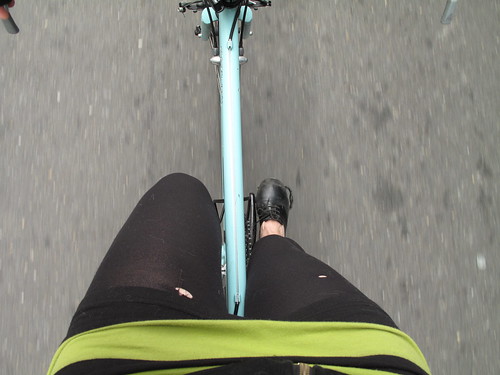 I was excited to join the ranks once again! [Note to self: Need new leggings.]
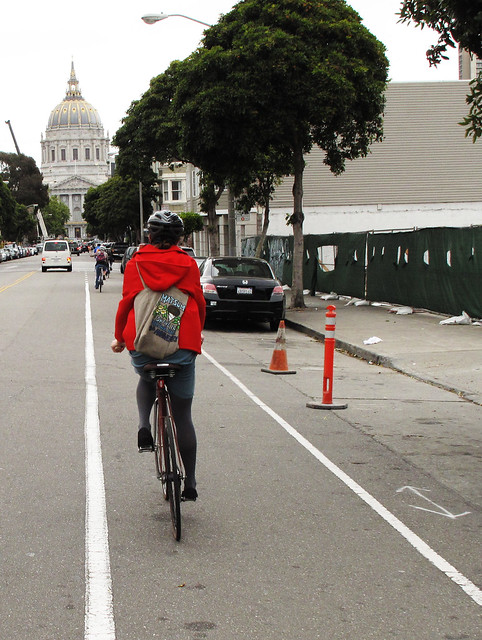
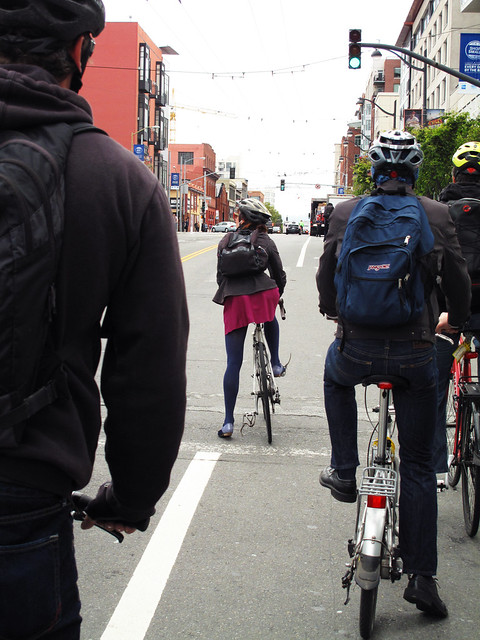 And witness the all the gorgeous SF landmarks on my way to work...
 while checking out the San Francisco style.
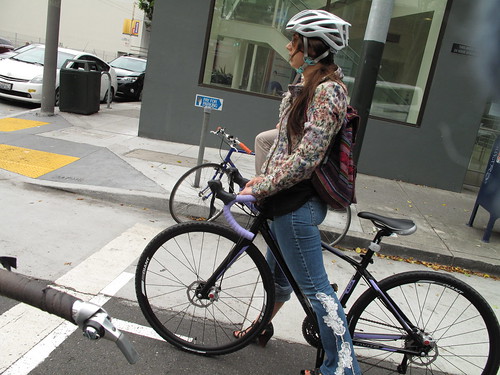 It's been a while since I've weathered the shit storm of the morning commute, so it took a little getting used to again.
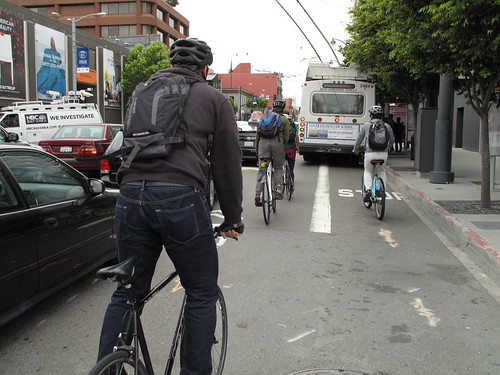 Even with all the positive changes to our bike infrastructure in the last few years -
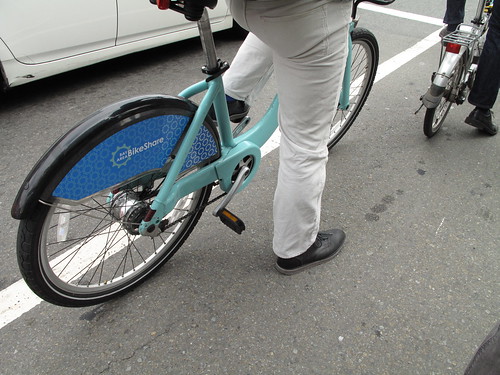 I'll admit it: I found the experience to be nervewracking and potentially dangerous.
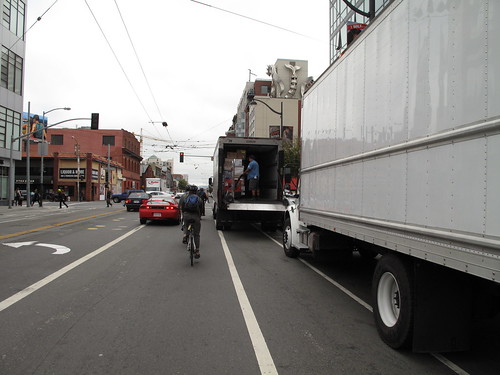 You still have to have thick skin to be confident enough to bike to work in San Francisco in 2014.
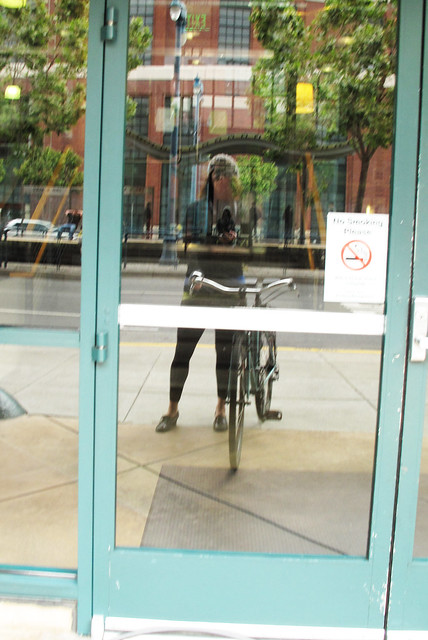 Still, I made it to my place of work, practicing safety in the form of Style Over Speed.
I was excited to join the ranks once again! [Note to self: Need new leggings.]
And witness the all the gorgeous SF landmarks on my way to work...
while checking out the San Francisco style.
It's been a while since I've weathered the shit storm of the morning commute, so it took a little getting used to again.
Even with all the positive changes to our bike infrastructure in the last few years -
I'll admit it: I found the experience to be nervewracking and potentially dangerous.
You still have to have thick skin to be confident enough to bike to work in San Francisco in 2014.
Still, I made it to my place of work, practicing safety in the form of Style Over Speed.
5.09.2014
on the day after Bike To Work Day
I am thinking of this film by Streetfilms that gives us a real-world example of what life in the city could be like.
Groningen: The World's Cycling City from STREETFILMS on Vimeo.
The film gives us all (unless we already live in Groningen), something to strive for! Dream on and ride on!4.30.2014
The Rise of Protected Bike Lanes (video)
While the rest of San Francisco is out riding around in this beautiful sunny weather, I'm sick at home with the flu. So what do I do? I'm spending time watching other people bike around on the interwebz! I'm particularly inspired by this video from People for Bikes Green Lane Project about the rise of protected bike lanes in North America, and I think you will be too.
The Rise of Protected Bike Lanes in the U.S. from Green Lane Project on Vimeo.
Yippee! As one new protected bike lane goes up on Polk Street in my own city of San Francisco, I am grateful for the fact that this trend is happening in other cities across the U.S. like Memphis and Chicago. There's light at the end of the sharrow!2.20.2014
Protected Intersections - an animated video demo
In the words of Lauryn Hill, "It could all be so simple, but you'd rather make it hard." This fantastic animation by Nick Falbo shows how some simple bike infrastructure could demystify how we could all pass through intersections in harmony, bicycles, automobiles and pedestrians alike, each with their own infrastructure.
Protected Intersections For Bicyclists from Nick Falbo on Vimeo.
Biking in urban areas doesn't have to be hard. But we need help from our city governments to give this idea for coexisting a fair chance.7.14.2013
prioritize the bicycle and they will ride
The Big Picture - 01 - Top 10 Bicycle-Friendly Design Elements in Copenhagen from Copenhagenize on Vimeo.
"If you build it, they will come." Watch Copenhagenize's point by point guide to how to design a modern bicycle city.
Subscribe to:
Posts (Atom)